Paralympics
Olympic Park, Sunday 2nd September 2012


The crowd in the Stadium was partisan but respectful and encouraged athletes of every nationality. They roared on Graeme Ballard and Libby Clegg to silver medals in their respective 100 metre categories but never failed in their appreciation of the winners from whatever country they represented.

As Pistorius settled into the blocks directly in front of us, he was expected to win the race and undoubtedly with no British athlete involved, the crowd wanted him to win the race. From the gun the South African powered into a massive lead off the bend and into the straight with literally nobody in sight, at this point from our seats it was easier to watch the screen as the last 80 metres of the race unfolded. Pistorius’ power was awesome and I thought he had the gold medal safely in his pocket when, from nowhere, Brazil’s Alan Oliveira ate up the 10 metre deficit to finish 0.07 seconds in front of the champion.

It was a stunning finish, and not until it was replayed on the screen did we realise from just how far back the Brazilian had come. It seemed impossible that anyone could make up such a deficit in such a short amount of time, and that is where the controversy began. Pistorius, in the emotion of an interview directly after the event, was less than gracious in defeat. He claimed that the length of Oliveira’s blades had made it an unfair race, claiming that it was something that he could not compete with. Without knowing the mechanics of the blades, it sounded like sour grapes but as the issue took up many column inches and television air time the next day, it was easier to understand the point he was making. Pistorius was more gracious the following day, offering a carefully worded statement in which he apologised for the timing of his comments and it was not his wish to deflect the attention from Oliveira’s moment, but still claiming that the issue of the blades was something that needed to be looked at after the Games.
From the moment we alighted at Stratford Station to be greeted by the welcome of the volunteering games makers and the first view of the Olympic Stadium, we just knew that this day was going to be something special. The heartache and the anger with the disappointment of being unable to acquire tickets for the Olympic Games was being washed away with atmosphere of the Park. If we had seen our tickets for the Paras as something of a consolation prize, then we were completely wrong.

The Park is a triumph that has seen the integration of the various venues into the natural habitat of what was part of Hackney Marshes. The waterways are beautifully landscaped with wild grasses and flowers that gave a natural, unmanicured look. We wandered from venue to venue to view each one with a certain pride that Great Britain had actually made the Games the undoubted success it has been. The focal point is obviously the Olympic Stadium, but the Velodrome cuts a pretty impressive figure and one that after the Games I will be endeavouring to get tickets for a cycling event to see from the inside. The Aquatics Centre has to be seen from a height to appreciate its splendour, at ground level it appears a bit bland. The Copperbox and The Cube, home to the handball and the basketball, are not aesthetically beautiful, but their colour adds to the Park a certain something. The Riverbank Arena is an obviously temporary structure that has generated the roars of the crowd during the hockey at the main games and the football in its various formats during the Paralympics.


The Orbit provides a focal point to the Park; the twisted metal structure provides an aerial viewpoint, if you managed to get a ticket that is, like everything else surrounding these Games, a complete sell-out.
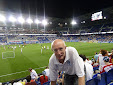
Inside the Olympic Stadium, I was initially as captivated by its majesty as I was at the opening of Wembley Stadium. Their usage is obviously very different and if, in the future, West Ham are to take occupancy and this becomes a football stadium, then it is going to be very interesting to see how they make this work because as it is now it does not lend itself to that purpose. We had seats in Row 5, at football they would be pretty poor viewing positions, but for athletics they were perfect.

The roof of the stadium only covers the top tier so we can be very thankful for the dry, warm day that we experienced, but I guess it is another construction alteration that would have to be considered should football take over its usage.
Our return journey was easy, from leaving our seats in the stadium to the platform at London Bridge took only an hour, true we had to stand on the Tube, but that happens most days for commuters. That hour and the rest of the journey home gave us time to reflect on our day and inevitably make the perhaps unfair comparison with our experiences at football grounds around the world.
The tribal football world is a completely different atmosphere to the family-orientated Olympic Games. For starters, the majority of the visitors at the Games are potentially cheering for just one country, Great Britain, but they were magnanimous towards every competitor. Drink is undoubtedly the catalyst of many of the problems at football. Alcohol was on offer at Olympic Park, but with the majority of its visitors being families, nobody was drinking to excess. I turned to Twitter for opinion; one reply concluded that the Olympics had been middle-class, whilst football was populated by chavs. To a point, I can accept that viewpoint, but with ticket prices at the height they are, isn’t football now the domain of the middle-class as well. I’m no sociologist, so I’ve no definitive answer but I think football has to look inwards at itself. Snarling players, unacceptable attitudes to match officials lends itself to similar behaviour from the terraces and, to many with families, this is not the atmosphere to which parents wish to bring their children. The Olympics in both guises has brought a utopian type of atmosphere that I trust will disappear as fast as the cauldron flame can be extinguished. In the entire day at Olympic Park not one swear word was heard, which was refreshing from the language that is heard (or suffered) even at Gillingham, which led me to be thankful for non-league football, but even that illusion was destroyed when I read of a fight at Tonbridge’s Saturday fixture with Basingstoke.
In the end, we have to be grateful that, in our lifetime, we have experienced an Olympics. The sceptics said that London could not make a success of the opportunity, they were wrong. London would grind to a halt with traffic problems, they were wrong. Those same sceptics will now be saying that there will be no legacy, that Olympic Park will become the nation’s while elephant, I hope they are wrong again.
My final reflection is that it was said at the start of the Paralympics that we should watch and ultimately remember the Games not for athletes with disability but with ability. When Oliveira and Pistorius fought every inch to the tape to Weir who added the cherry to our cake; from high jumpers clearing to 2 metres on one leg to discus throwers with no sight, we forgot that we were watching athletes with any disability we were watching only athletes.


Labels: Paralympics
posted by baldangel @ 08:43
0 Comments


0 Comments:
Post a Comment
Subscribe to Post Comments [Atom]
<< Home